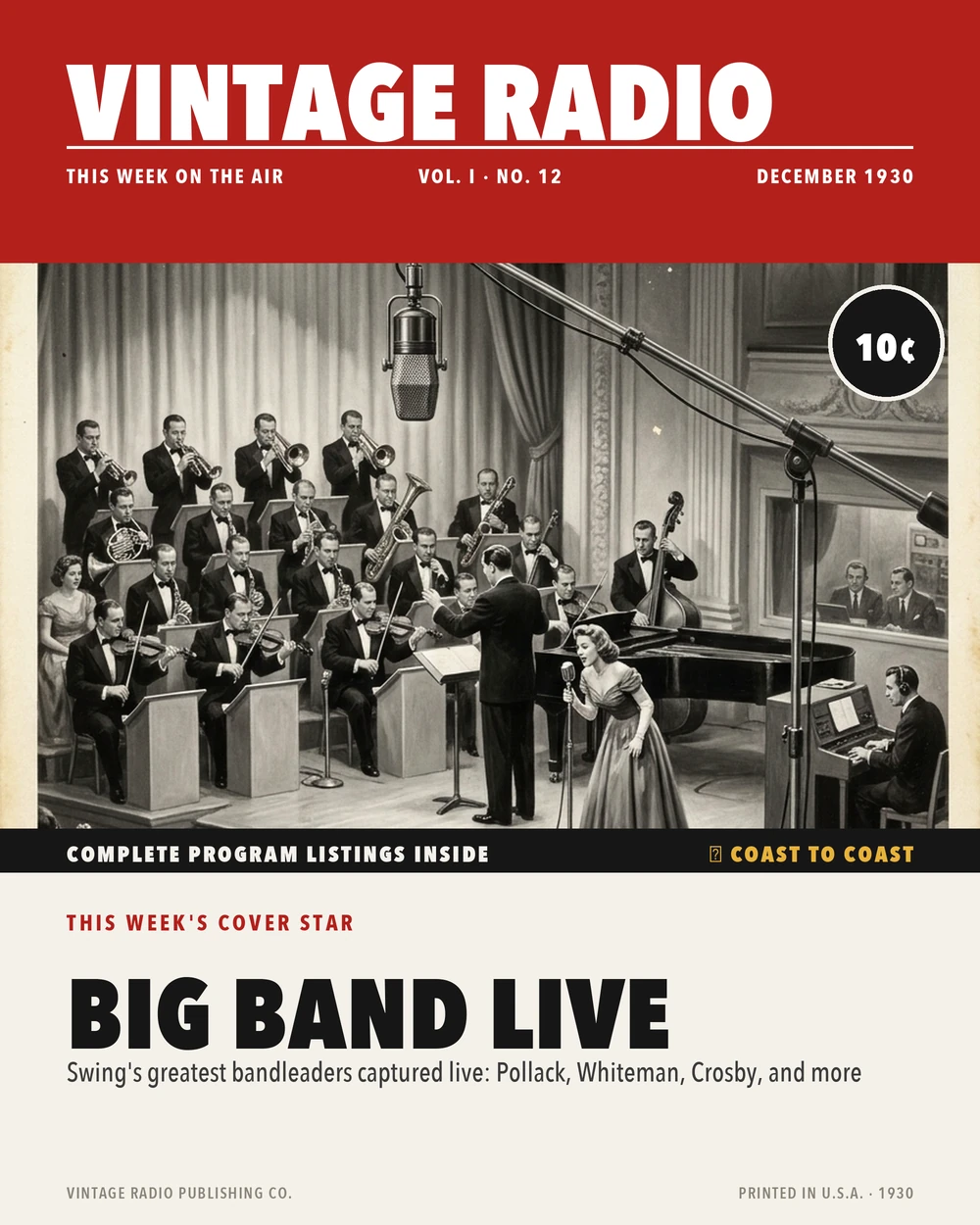
Big Band Live
What This Catalog Is
Big Band Live is not a single program with a fixed cast and a network home. It's a catalog — 190 episodes spanning four decades, from June 1930 through December 1970 — that collects the remote broadcasts, sponsored showcases, and live-venue airings that were the backbone of American music radio throughout the swing era and beyond. The episodes pull together performances from some of the most recognizable names in dance band history: Ben Pollack, Gus Arnheim, Bob Crosby, Joe Sanders, and Paul Whiteman among them. What holds the collection together isn't a single host or a single sound but the form itself: the live broadcast, with an orchestra in a ballroom or a studio and an audience somewhere listening in.
Remote broadcasts like these were how most Americans first heard big band music. An orchestra set up at a hotel ballroom or a restaurant, the engineer ran a line back to the local affiliate, and the music went out live over the network. The performances in this catalog come from exactly that world — some from commercial sponsors buying time for their products, others straight from the bandstand at places like the Blackhawk Restaurant in Chicago.
Ben Pollack and the Early Broadcasts
The catalog opens in the summer of 1930 with a remote featuring Ben Pollack at WBS, and that starting point matters. Pollack is sometimes called the "Father of Swing" — not because he created the genre single-handedly, but because he had an unusual talent for identifying and hiring musicians who would go on to define it. Benny Goodman, Glenn Miller, Jack Teagarden, Jimmy McPartland, and Harry James all played in Pollack bands at one point or another. Hearing a Pollack broadcast from 1930 means hearing an orchestra that was, in effect, a finishing school for the next generation of bandleaders.
Pollack's band broke up in 1935, and the story of what happened next is one of the more interesting footnotes in big band history. Many of the departing musicians formed a new orchestra and needed a front man. They settled on Bob Crosby — younger brother of Bing — who was elected to lead a band made up largely of players he hadn't assembled himself. That band would show up repeatedly in the Big Band Live catalog.
Gus Arnheim and the Cocoanut Grove Sound
Gus Arnheim and His Orchestra appear here performing "Its Love" and "You Really Started Somethin'," and Arnheim was one of the defining figures of the West Coast dance band scene in the late 1920s and early 1930s. He held a residency at the Cocoanut Grove nightclub inside the Ambassador Hotel in Los Angeles from 1928 to 1932, and his radio broadcasts from that room helped establish the venue as one of the premier dance spots in the country. He recorded for OKeh, Victor, and Brunswick during this period.
What made Arnheim's broadcasts particularly significant was what happened when the Rhythm Boys vocal trio joined his orchestra in 1930. That group included Bing Crosby, Harry Barris, and Al Rinker, and Arnheim's radio airings featuring Crosby's solo vocals are widely credited with launching Crosby's career as a solo artist. Arnheim was also heard nationally on the Lucky Strike Dance Hour on NBC during the early 1930s, which gave his orchestra reach well beyond Southern California.
Bob Crosby and the Ford V-8 Revue
Bob Crosby turns up in the catalog in a sponsored context — the Ford V-8 Revue, a program bankrolled by Ford Motor Company's V-8 line. The surviving episodes include performances of "It's You Im Talking About," "Muskrat Ramble," "Oh My Goodness," and "Therell Be Some Changes Made." At least four numbered programs from the Ford V-8 Revue survive and are held at the Library of Congress.
What's worth knowing about the Bob Crosby Orchestra is that it carried two distinct identities within a single ensemble. The full orchestra played the standard dance band book, but nested inside it was a smaller group called the Bob-Cats — a Dixieland octet featuring soloists, many of them from New Orleans, who would step out for hot small-group numbers. "Muskrat Ramble" is exactly the kind of tune the Bob-Cats would have owned. This dual personality gave the Crosby band a range that most swing orchestras didn't have.
The band's engagement at the Blackhawk Restaurant in Chicago in the late winter of 1938 included eleven national broadcasts per week — a pace that would have made the Crosby name familiar to listeners across the country in a very short span of time. Later, Bob Crosby hosted radio variety series on NBC and CBS between 1943 and 1950, extending his presence in radio well past the height of the swing era.
The Blackhawk Restaurant and Joe Sanders
One of the most historically grounded broadcasts in the catalog is the remote from the Blackhawk Restaurant in Chicago, featuring Joe Sanders and the Nighthawks. A surviving listing places this broadcast on March 25, 1937, carried over WGN Radio and the Mutual Broadcasting System. That dual-network detail matters: the Blackhawk had been broadcasting nationally since September 1926, when the Coon-Sanders Kansas City Nighthawks began their residency there, with WGN carrying the signal. By the mid-1930s, MBS was also involved.
The Coon-Sanders Nighthawks — co-led by Carleton Coon and Joe Sanders — had formed in Kansas City in 1920 and began broadcasting on radio the following year. Their late-night airings earned them the "Nighthawks" name, and the Blackhawk residency made them nationally known. The broadcasts became popular enough that a telegraph machine was installed at the venue to handle remote listener requests. When Carleton Coon died in May 1932, Sanders continued briefly under his own name before disbanding the group on Easter Sunday 1933. He reformed as Joe Sanders and His Orchestra in 1934, which remained active for nearly two decades, and it's that later version of the ensemble that appears in the 1937 Blackhawk remote.
Kraft Music Hall and Paul Whiteman
The catalog also includes an episode from Kraft Music Hall under Paul Whiteman's name, titled "Loves Sweeping Country." Kraft Music Hall debuted on NBC on June 26, 1933, as a musical-variety program — it went through a couple of name variations, including "Kraft Musical Revue," before settling on its final title in 1934. Whiteman hosted through December 1935, after which the program transitioned to Bing Crosby, who remained host through 1946.
Whiteman's presence in the catalog connects the collection to an earlier chapter of American popular music. He had been one of the most prominent orchestra leaders of the 1920s, and his involvement with the early Kraft broadcasts carried that prestige into the new sponsored-radio format that would define the 1930s.
Four Decades on the Air
The span of this catalog — 1930 to 1970 — traces the full arc of big band radio, from the moment when remote broadcasts were the primary way orchestras reached national audiences, through the swing era's peak years, and into a period when the form had become largely nostalgic. The 190 episodes here don't tell a single linear story, but taken together they preserve a cross-section of what American music radio actually sounded like when the orchestras were playing live and the networks were carrying the signal coast to coast.